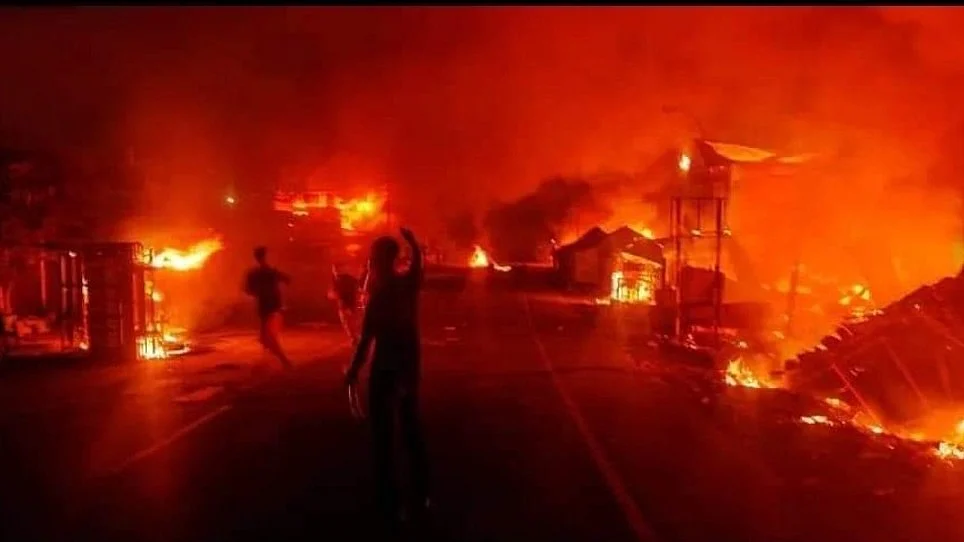
Buildings burning during the May 2023 outbreak of ethnic violence in Manipur, crowd watching in the foreground

What Was Allowed
to Happen
in Manipur.

Three years and Two communities. One state that had the men, the arms, and the time to stop this but It chose not to.

Read the record
0 dead, official count (Nov 2024)
0 displaced from their homes
0 weapons looted from police armouries
0 years and counting

No single riot caused this. Three years of inaction did.

II

The Flashpoints

No single day. A sequence of deliberate choices to stand down.

May 3, 2023
The spark

A court order, A march. Then it didn't stop.

A High Court order on tribal status triggered a solidarity march. The march met counter-mobilisation. By nightfall, Manipur was burning. Three years later, it still hasn't fully stopped.

Source: Wikipedia, 2023–2026 Manipur conflict, citing contemporaneous reporting
May 4, 2023

Twenty guards. Six thousand guns gone by morning.

A mob broke into the Manipur Police Training Centre at Pangei. Twenty guards, outnumbered, fired blank rounds and were overrun. Within days, roughly 6,000 firearms had vanished from state armouries. More than half are still unaccounted for.

Source: ThePrint, reporting on armoury looting, 2023–2025

May 3–4, 2023

Two women reached a police van. They were left to the mob.

According to the CBI's own charge sheet, two Kuki-Zo women who would later be paraded naked and assaulted had first reached a police vehicle and asked to be driven to safety. The officers refused and drove off. What happened next was filmed.

Source: The Wire, reporting on CBI charge sheet, April 2024

July 19, 2023
The turn

The video was 2 months old before the country saw it

The footage of the assault took over two months to surface nationally, slowed by an internet shutdown in Manipur that rights groups widely criticised. Arrests followed only after the video went viral, not after the original police complaint. Parliament was disrupted for three days demanding a response.

What was said

Coverage largely began and ended with outrage at the video itself: a single, shocking clip standing in for the story.

What was left out

The men in the footage were identifiable from day one. It was the internet shutdown and institutional inertia, not lack of evidence, that delayed any response for months.

Source: BBC, CNN, July 2023

Through 2023–24

CCTV shows uniformed police setting fires

January 2024 CCTV footage captured Manipur Police commandos and Meitei vigilante group members setting fire to homes, a school, and a church hall in Moreh. A central paramilitary force stood by and did not intervene. Rights groups documented a broader pattern: armed vigilante outfits operating for months with little to no consequence.

Source: Newsreel Asia, citing CCTV footage and local reporting

February 2025

The Chief Minister resigns. Delhi takes direct control.

Facing a no-confidence motion after 20 months of intermittent violence, Chief Minister N. Biren Singh resigned. President's Rule was imposed days later: a direct admission that the state's own police force could no longer be trusted to enforce the law.

Source: Wikipedia, 2023–2026 Manipur conflict

August 2025
The finding

"Not spontaneous: planned, and facilitated by state failures"

A 694-page independent tribunal report, led by former Supreme Court judge Justice Kurian Joseph, concluded the violence was planned, ethnically targeted, and enabled by state failure. FIRs were filed selectively. Investigations were delayed. Security forces were accused of active complicity. Both state and central governments were indicted for "enabling impunity."

Source: The Wire, reporting on the PUCL Independent People's Tribunal, August 2025

February 2026

President's Rule lifted. A new government sworn in.

Almost exactly a year after direct central rule began, it ended: a new Chief Minister took office and Manipur's elected government was restored. The conflict was not resolved when this happened. It was still active.

Source: Wikipedia, 2023–2026 Manipur conflict

2026–Present
Still unresolved

Drone attacks, bombings, and weapons still missing

By mid-2026, militant groups had escalated to coordinated drone strikes near the Myanmar border. A bomb attack in April killed two children in their home. Most of the ~6,000 weapons looted in 2023 are still unaccounted for. The government's own Commission of Inquiry has had its deadline pushed back repeatedly, most recently to November 2026.

What gets covered

Each new incident is reported as an isolated flare-up: a bombing here, a clash there.

What's missing

The throughline: the same unrecovered weapons, the same stalled inquiry, the same institutional gap, three years running.

Source: Eurasia Review, South Asia Terrorism Portal data, May 2026

Every entry above documents a legal breach. The state drafted these laws and The state itself violated them.

III

The Standard, and Who Failed It

Five explicit obligations bound the state. Here is where the official record proves abandonment.

01

Protect life, regardless of community.

The state's most basic obligation. Security forces exist to stop violence, not to pick a side in it.

02

Secure the armouries.

Police weapons cannot become the conflict's weapons. That line failed on day two.

03

File the complaint. Every time, without delay.

An FIR is the starting point for justice. Selectively filing them is a choice, not an oversight.

04

No armed group operates above the law.

Vigilante militias functioning for months with impunity is a state choosing not to act.

05

Account immediately. Do not hide behind blackouts.

A response delayed for months, arriving only after public outrage forces it, is itself a form of failure.

Where the State Failed

Breaks Rule 02

Twenty guards, thousands of weapons, no real resistance

Roughly 6,000 firearms were looted from state armouries within days of the outbreak. More than half remain unrecovered three years later. Security officials cite these looted weapons as the reason the conflict escalated from riots to sustained armed violence.

Source: ThePrint, The Wire, 2023–2025

Breaks Rules 01 & 03

Police turned away women who asked for protection

The CBI's own charge sheet states two women were left by police who declined to drive them to safety, hours before they were assaulted on camera. This was not absence. It was a decision made in the moment.

Source: The Wire, reporting on CBI charge sheet, 2024

Breaks Rule 04

Uniformed personnel filmed setting fires, allegedly alongside a militia

CCTV from January 2024 showed Manipur Police commandos and Meitei vigilante group members burning homes and a church hall, while a central paramilitary force stood by. Both the vigilante activity and the standing-by are failures of the same rule.

Source: Newsreel Asia, 2024

Breaks Rule 03

An independent tribunal called it "planned," not spontaneous

A 694-page report led by former Supreme Court Justice Kurian Joseph found FIRs were filed selectively, investigations were delayed, and security forces faced credible accusations of active complicity, not just negligence.

Source: PUCL Independent People's Tribunal, via The Wire, 2025

Three years. 258 dead. 60,000 displaced. Most of six thousand stolen weapons still unrecovered. An inquiry that keeps getting pushed back.

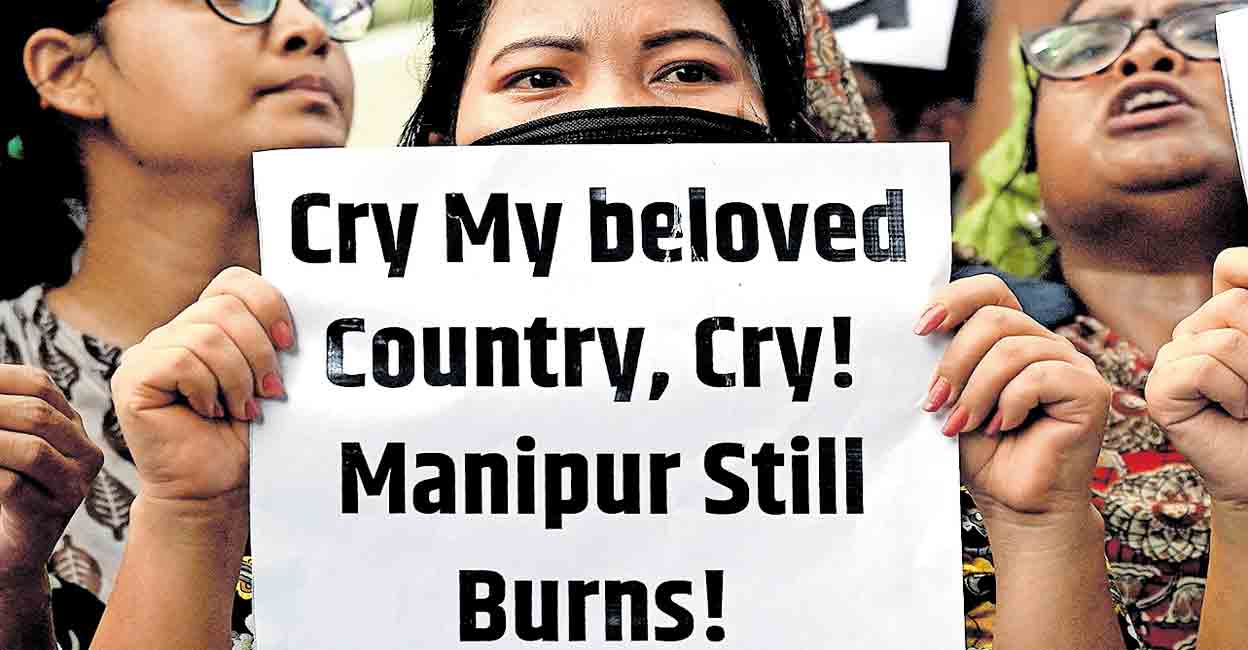
Protester holding a sign reading 'Cry My Beloved Country, Cry!' at a demonstration

"Cry my beloved country, cry." That's not our line. It's what someone had to write on cardboard because no institution would say it for them. This site exists because that piece of cardboard shouldn't have had to.

The Flag in Your Tab

These are the Four colors for a land that failed to hold them together.

Yellow for the valley. Blue for the waters. Red for the blood. Green for the hills.

This four-stripe banner emerged from self-determination movements: a visual claim to an undivided Kangleipak. It was never a government flag, nor a piece of state bureaucracy. It was an assertion of what the land was supposed to be: valley and hills tied under one horizon.

Shrunk to 32 pixels in your tab, A small, quiet reminder of a unity the state failed to protect.